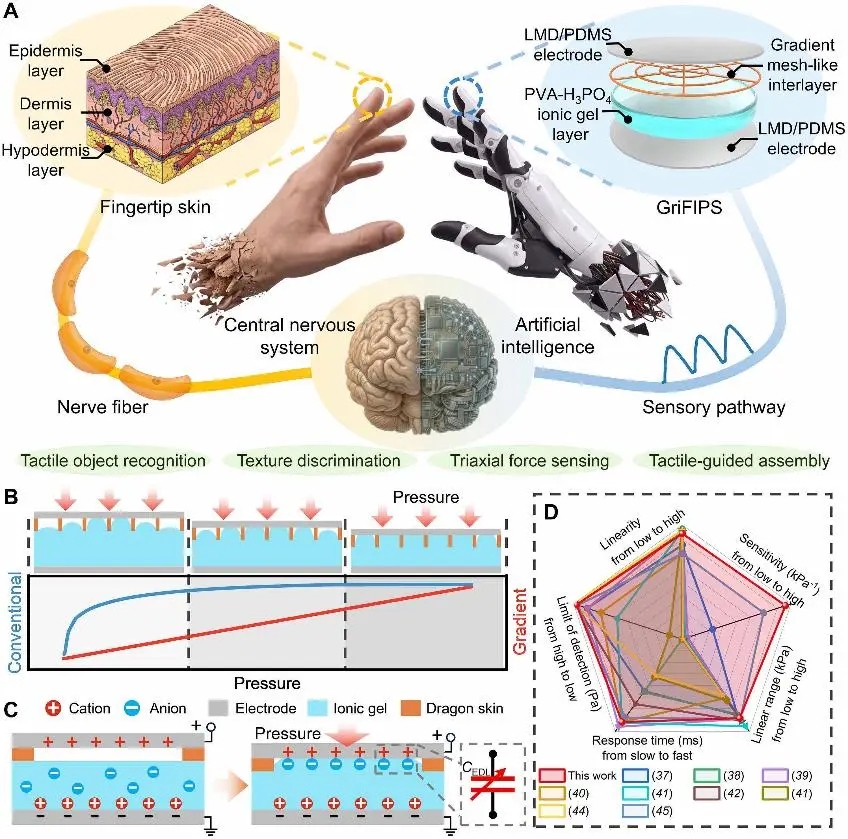
A research team led by Zhang Shiwu and Dong Shuai from the School of Engineering Science and the Institute for Humanoid Robotics, University of Science and Technology of China (USTC), has made new progress in flexible tactile sensing and robotic perception. Inspired by the gradient distribution of mechanoreceptors in human fingertip skin, the team proposed a flexible iontronic pressure sensor with a gradient interlayer (GriFIPS). This gradient interlayer regulates the sequential contact process between electrodes and ionic gel, simultaneously achieving high sensitivity, a wide linear range and high linearity. The device was further developed into a three-axis force sensor for robotic tactile manipulation. The relevant research, titled Gradient-interlayer–based flexible pressure sensors for high-performance robotic perception, has been published in Science Advances.
Tactile perception lays a critical foundation for humanoid robots to perform dexterous manipulation, human–robot interaction and understand complex environments. Robots need to detect gentle touches with sharp sensitivity, while distinguishing subtle pressure variations under large gripping forces. This imposes stringent requirements on the sensitivity, measurement range and linearity of sensors at the same time. Nevertheless, the electrode–ionic gel interface of conventional flexible iontronic sensors easily reaches contact saturation rapidly under compression, which reduces sensitivity at high pressure and causes severe nonlinearity. Existing studies mostly improve partial performance via microstructural design of functional layers or gradient-modulus stacking, yet these approaches usually require complicated multi-step fabrication procedures and hinder practical deployment of the devices.
Design and Working Mechanism of the Gradient-Interlayer Flexible Iontronic Pressure Sensor (GriFIPS)
To tackle this challenge, the researchers introduced a standalone elastic mesh interlayer between the flexible electrode and ionic gel. Using direct ink writing (DIW) printing, they fabricated a radial gradient mesh structure with a line width of around 100 μm, where mesh pores gradually expand from the center outward. As pressure rises, the contact between the ionic gel and the electrode expands zone by zone from the center to the periphery under the constraint of the mesh. This effect works synergistically with the evolving local contact on the microscopically rough surface of the liquid-metal composite electrode, effectively delaying interfacial contact saturation. Combining macroscopic contact area modulation with microscopic interfacial response, this design offers a new route to break the trade-off bottleneck among sensitivity, range and linearity for flexible iontronic sensors.
Experimental results show that the sensor achieves a sensitivity of 175.9 kPa⁻¹, a linear range of approximately 360 kPa, and a linear fitting coefficient of determination R² = 0.997. Its limit of detection is as low as roughly 2.1 Pa, with a response time of around 25 ms. Under preloads of 100 kPa, 200 kPa and 300 kPa, the device can still discriminate tiny pressure increments of about 40 Pa. After more than 6,000 loading cycles at 150 kPa and 2,000 stretching cycles at 50% strain, its sensing performance remains stable, demonstrating favourable reliability and promising potential for robotic contact perception.
On this basis, the team further constructed a three-axis flexible iontronic force sensor (3-axis GriFIPS) using a four-segment electrode and hemispherical elastic bumps. Normal force and shear force can be resolved via coordinated responses of each segment, and surface texture features can be captured. Combined with temporal convolutional network algorithms, the single-channel pressure sensor and three-axis force sensor realized tactile recognition of 14 object types and 12 fabric types respectively, achieving recognition accuracies of 99.86% and 99.72% on the test set used in the paper.
After integrating the sensors onto a robotic dexterous hand, the system can sense load changes in real time during grasping: it identifies lateral pulling force during handover between human and robot and releases the grip actively, and stops insertion and retracts promptly when resistance is encountered in blind-hole assembly. These tests verify the vital support of tactile feedback for dexterous robotic manipulation.
This study presents a design strategy that tunes interfacial contact evolution through an independent gradient interlayer. It provides a new technical pathway for developing flexible tactile sensors with high sensitivity, wide linear range and mechanical stability, and supplies a hardware basis for contact perception and fine manipulation of robots under vision-limited conditions. Moreover, this strategy can be extended to various flexible pressure sensors including iontronic, piezoresistive and capacitive types.